MycPermCheck
The Mycobacterium tuberculosis permeability prediction tool for small molecules
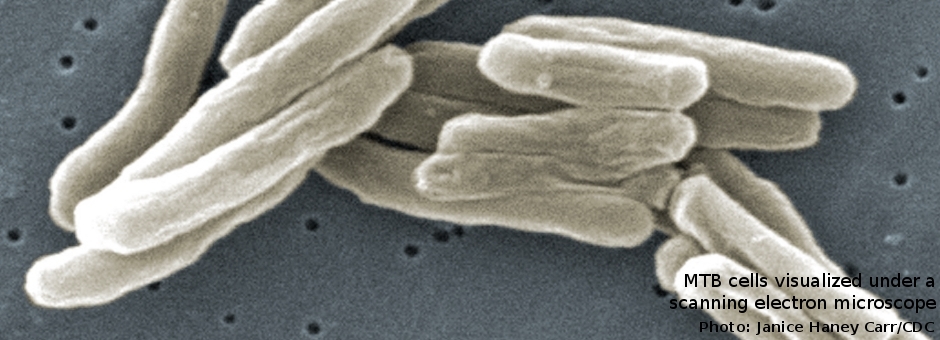
MycPermCheck is a tool for permeability prediction of small molecules against Mycobacterium tuberculosis. Basis of the prediction program is a logistic regression model of the physico-chemical properties of permeable substances, based on the work of Benjamin Merget published in 2013.
The tool is provided as a Perl script (CC BY-ND 4.0 license), along with a small evaluation data set for testing: csv-files with QikProp or Padel descriptors (evaluation_data.zip) and a PDF-document illustrating the structures of the compounds (evaluation_data.pdf).
Help
The Mycobacterium tuberculosis permeability checker for small molecules uses the physico-chemical descriptors calculated by Schrodinger® Maestro QikProp or the open-source package PaDEL-Descriptor to calculate the coordinate of principal component 1 of a PCA of the training dataset (Ekins et al. 2010). This coordinate is then used as input for a logistic regression model. As a result the user retrieves a probability of permeability for each molecule of interest.
The input format (QikProp or PaDEL CSV) is recognized automatically and provided via "-i <input file>". Please consider that the regression model used by MycPermCheck depends on the input format.
If your file contains several molecules with the same name (e.g. tautomers, protomers, stereo isomers, etc.), you start mycpermcheck with the option "-c m" to invoke the calculation mode "Calculate Mean of Isomeric Forms". In this case the values of the descriptors are averaged for all same-named molecules. If your file contains several same-named molecules and only the first molecule of this group should be picked unchanged as a representative for all, use the option "-c f" (first molecule used as representative of all identically named). Please note that your molecule names should not contain special characters.
The output can be sorted in different ways via the -s option: "-s <sort mode>", where sort modes can be n (by name), o (off, order is unchanged) or p (by probability, default).
If you use MycPermCheck, please cite:
Merget et al. (2013) MycPermCheck: The Mycobacterium tuberculosis permeability prediction tool for small molecules, Bioinformatics, 29(1): 62-68.
If you use the PaDEL-Descriptor-based model, please do not forget to also cite:
Yap C.W. (2011). PaDEL-Descriptor: An open source software to calculate molecular descriptors and fingerprints, Journal of Computational Chemistry, 32(7): 1466-1474.
How to calculate molecular descriptor data: To calculate descriptor data with QikProp or PaDEL you need a common 3D-structure coordinate file, like mol2 or sdf. Common chemical sketching programs (like ChemDraw) have an export function to SMILES format. This format is a linear string, coding the 2D connectivity of your chemical structure including stereochemical information and a title. You can use open-source software like OpenBabel to convert this SMILES-string to a three-dimensional mol2 file or several web services, e.g. Cactus. The resulting 3D mol2 files should be checked for errors with a molecular viewer, like PyMOL, VMD or Avogadro. Eventually, the mol2 file(s) can be used as input for PaDEL-Descriptor or QikProp. But of course, there are countless ways of obtaining 3D structures from chemical sketches.
History
2026: Access to the former webservice indicated in the publication is discontinued. All data is now provided via this page.
2018-12-03: Download version of MycPermCheck is available now! The webservice will no longer be available.
2014-10-20: Version 1.1 of MycPermCheck is available now!
2014-02-11: The direct SDF upload support has been deactivated temporarily due to server issues. Please download and use the stand-alone version of PaDEL-Descriptor to use the PaDEL-based MycPermCheck model.
2013-02-01: MycPermCheck now supports structure-data file (SDF) input with on the fly descriptor calculation. For this feature, PaDEL-Descriptor and its associated MycPermCheck model is used.
2012-12-20: The final version of the publication is available!
2012-10-26: The Advance Access version of the MycPermCheck paper is published in Bioinformatics